

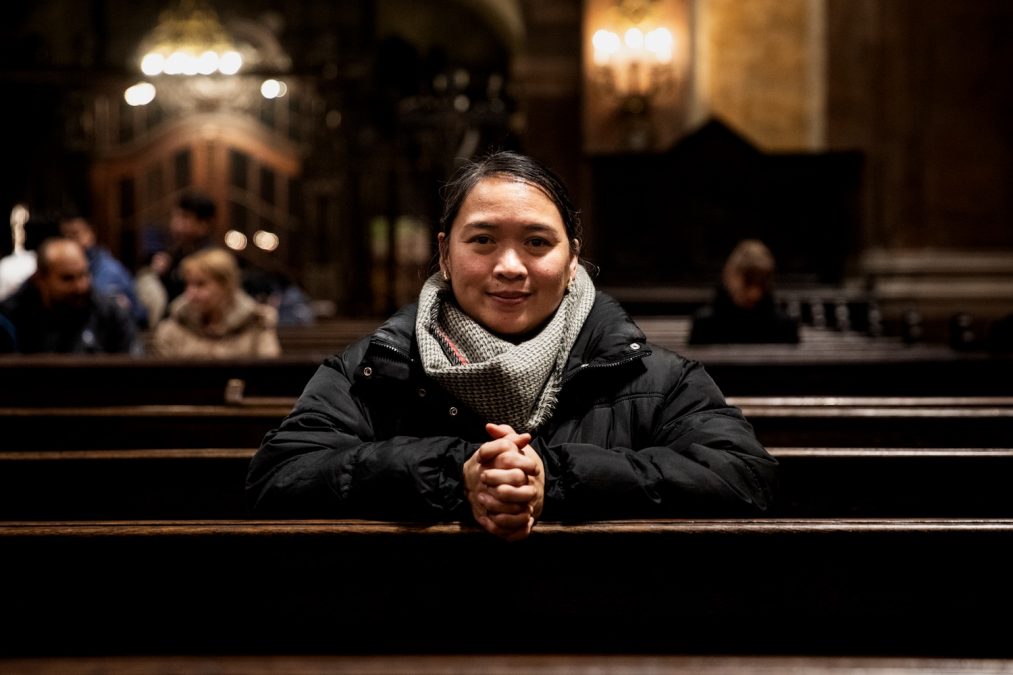
Migration debates often highlight the clash of cultures, in both positive and negative tones. But what if the largest group of guest workers comes from a distant culture that is Christian – indeed, arguably more so than the host nation, which sees itself as a bastion of Christianity? On an increasing number of Sundays, the Franciscan church in central Budapest fills with Filipinos who travel from workers’ hostels in the capital and the countryside to celebrate Christ’s sacrifice in their own language. The community now has Masses in more and more Hungarian cities, and a Filipino priest visits hostels across the country to support thousands of compatriots living far from home. What’s more, some are even thinking of staying longer. This report looks at how Hungary’s Filipino community is preparing for Christmas

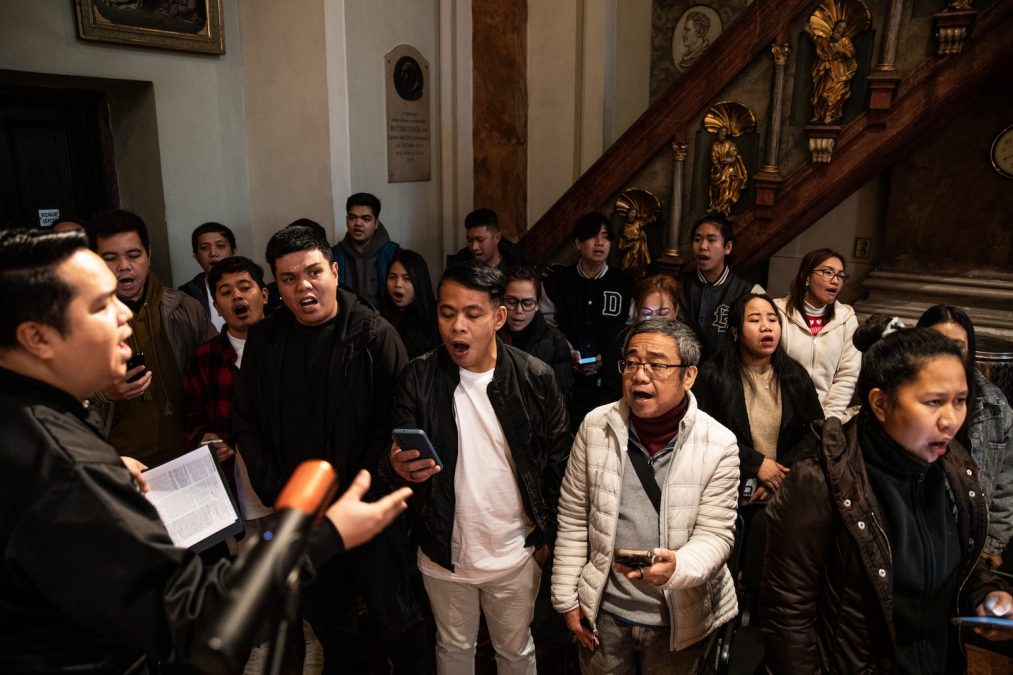
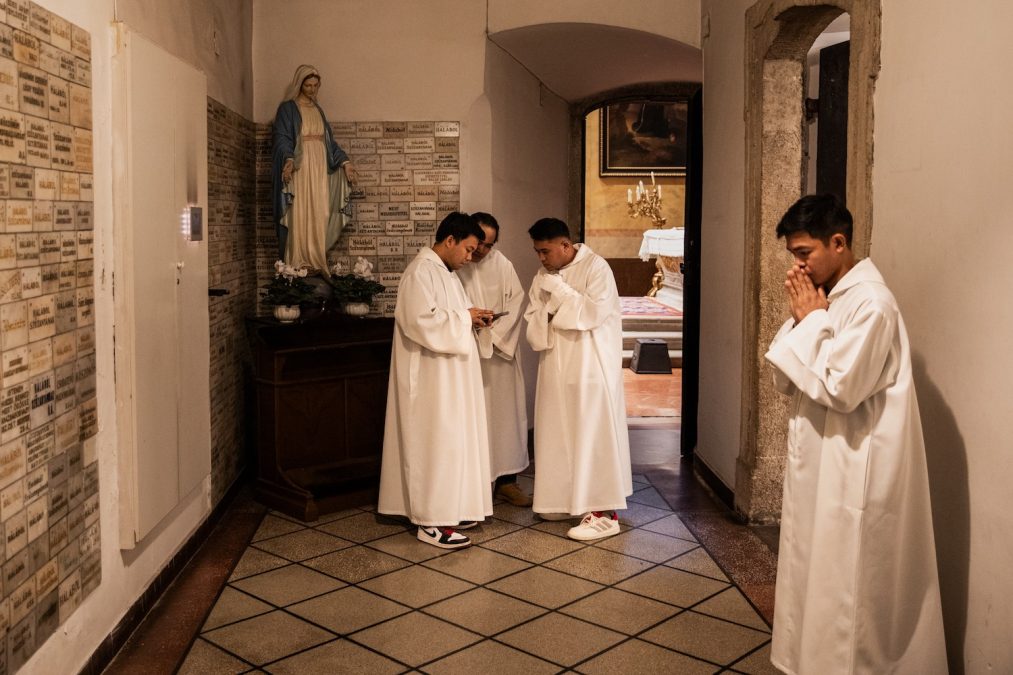
In the Philippines, it is almost unthinkable to celebrate Mass without a small army of helpers around the priest. There are at least four or five altar servers, as many readers of the Scriptures and intercessions, and ushers collecting the offerings. Echoing the ancient minor order of ostiaries, “doorkeepers” welcome the faithful at the entrance and guide them to empty seats. Before Mass, a “master of ceremonies” announces intentions; afterwards, they read out notices and community events.
The music is provided by a choir of dozens of volunteers. In fact, so many people apply for this role that different groups often take turns from week to week, singing and accompanying the distinct Filipino liturgical music – rooted in both ancient local traditions and Spanish heritage – typically on piano or guitar.
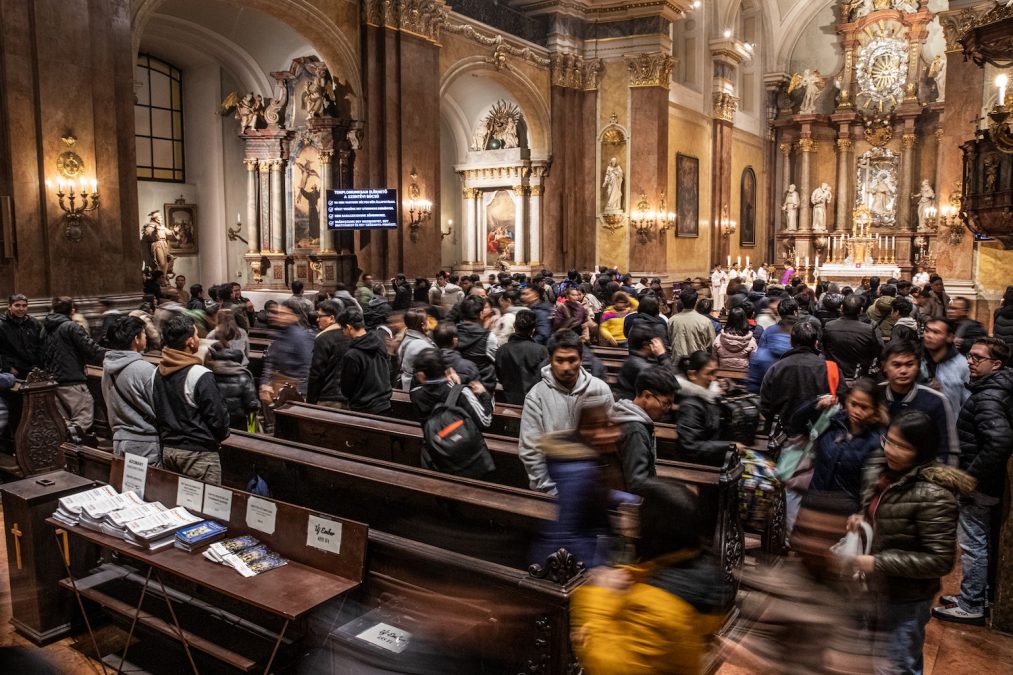
Something similar has unfolded over the past year or so at Budapest’s Ferenciek terre: on an increasing number of Sunday afternoons, the Franciscan church fills to capacity with Filipinos. There, Father Phoebie Fababair, a Franciscan, celebrates the liturgy in Tagalog – but switches into English roughly every third sentence during the homily. This kind of code-switching (“Taglish”) is common among Filipinos, especially when dealing with more complex ideas: their modern conceptual vocabulary rests on English terminology, a legacy of American colonial rule, and English remains the primary language of public education. (The archipelago came under U.S. control after the Spanish–American War in 1898 and gained independence in 1946.)
The linguistic mix has still more layers: many religious terms in Tagalog are of Spanish origin (such as Espiritu Santo). After all, the Filipinos received Christianity from the Spaniards – along with their surnames, and even the name of their country and people, which honour a king of Spain. Some say the evangelisation began with Magellan’s arrival in 1521; others point to the Spaniards’ lasting return in 1565 as the true starting point. Either way, today 79 percent of the country’s population is Catholic, making it the largest Christian nation in Asia.
Filipino “Rooster Mass” and the dream of a church
In Budapest, the life of the Filipino Catholic community is organized by Leah de Leon, who has lived in Hungary for 18 years. She makes sure that every liturgical ministry is covered each week – a demanding task, given that most of the faithful work in factories with rotating shifts and cannot always attend on Sundays. Leah is proud that the choir has grown to over 35 members in just a year, and that the music sounds as if they were back home. Not long ago, she would have thought this impossible. Leah came to Hungary through marriage, and for nearly fifteen years the Filipino community in Budapest never reached one hundred people. Those who were here attended English-language Masses – first in Mária Street, later at St Stephen’s Basilica.

Then in 2021, the Hungarian government opened the door for Asian guest workers to take up employment in Hungary under regulated conditions and fixed-term contracts in designated shortage occupations. Today, according to the latest estimates, around 14,000 Filipinos work in Hungary. At the Franciscan church in Pest alone, at least 300 people gather every week – and on major feast days there is hardly space to stand.
“Now that there are so many of us, and we have truly become a community, my life has found a new purpose,” says Leah, a mother of two, and the beating heart of the parish.
She knows just how vital faith life is for her compatriots: often it is the only thing that lifts them out of the daily rhythm between factory floor and workers’ hostel. When we speak, she is in the middle of organising a community gathering, and she proudly explains that for the first time, the Filipinos will celebrate Simbang Gabi at the Pasarét Franciscan church. Central European Catholics cherish their Rorate Masses, but the Philippines has a similar tradition: during the Christmas novena, the nine days before the feast are marked by dawn Masses awaiting Christ’s coming. The nine days symbolise the nine months in the womb of the Blessed Virgin Mary, and the early hour once reflected a farming lifestyle – hence the nickname “rooster Mass”.
The community’s long-term dream is to receive a church of their own, where they can display images and statues of their saints, and where, beyond the weekly Mass, they could hold the novenas and processions that fill the Filipino liturgical year. Whether that will come to pass remains an open question for the future.
The son of guest workers, now a “guest worker” priest
From a European perspective, the Philippines – a nation of 112 million – is not a rich country: measured in purchasing power, its GDP per capita is a quarter of Hungary’s. For decades, the country’s economic strategy has relied on labour export. Those who work abroad have a name of their own: Overseas Filipino Workers (OFWs). A well-oiled system screens applicants at home for qualifications and background. They often apply to several potential destination countries, and do not know in advance where they will end up – rather like a university admissions process. We spoke to one guest worker in Budapest who had originally intended to go to Taiwan. The strategy assumes that workers will return after acquiring Western work culture and industrial standards, putting their experience to use at home; permanent immigration is not the aim, though it does happen sometimes.


hirdetés
Father Elmer Escalona Hernandez, a 42-year-old Divine Word Missionary, is the child of such guest workers – indeed, his parents are still working in Italy today. Shortly after his birth, his father left to work in Saudi Arabia. He grew up with his siblings on the island of Mindoro, south of Luzon, where the capital, Manila, lies. Today he is a priest of the Diocese of Szombathely in Western Hungary. In autumn 2024, the Hungarian Catholic Bishops’ Conference tasked him with coordinating pastoral care for Filipino guest workers living in the country – yet he continues to serve the faithful of Vasvár and five surrounding villages as chaplain, alongside an Indonesian parish priest and a Vietnamese assistant priest, both also Divine Word Missionaries.
Father Elmer now feels almost as rooted in Hungary as in his birthplace. After the communist takeover, five Divine Word Missionaries were sent from Hungary to the Philippines. Beyond administering the sacraments, they taught and built schools, hospitals and churches – today, they are buried in a cemetery in Quezon City, near Manila. One of them, Father Lajos Halász, served on Mindoro, the very island where Father Elmer grew up. Although he attended a Divine Word parish and secondary school, he did not know then that one of the buildings had been erected by a Hungarian priest. “To us, every white person looked the same,” he recalls. He only realised the connection years later, in 2007, when he arrived in Hungary as a professed member of the order.
Hungary as mission territory?
As the name suggests, the Divine Word Missionaries are a missionary order, founded in 1875 – they send priests wherever they are needed most. Hungary – where vocations are declining dramatically – has increasingly become such a place. László Németh, now Archbishop of Belgrade and a cardinal (we interviewed him earlier this year), also served in the Philippines for a while. During his time as provincial of the order in Hungary, he asked Manila to send a seminarian here. Father Elmer was happy to come, though he knew little about Europe beyond the idea that, unlike in the Philippines, one could speak plainly without people taking offence. He had hardly any information about Hungary, but he was not afraid to go.
“It doesn’t matter whether the people there are white, black or yellow – God is already there before we arrive. Why should I have been afraid?” Father Elmer recalls.
It is also crucial though, he adds, that a missionary learns the language of the people he serves. He now speaks Hungarian fluently. He took his perpetual vows and was ordained deacon here – but travelled home in 2019 for his priestly ordination. Afterwards he first served as chaplain in Mélykút, before moving to Vasvár. Although he has never served as a priest in his homeland, he sees clearly how different the religious landscape is between the two countries.

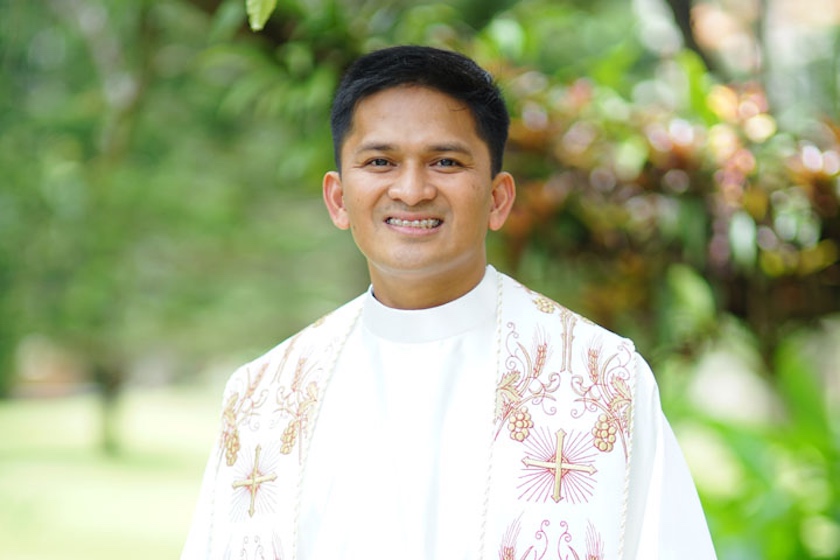
In the Philippines, the greatest challenge is not the shortage of priests – there are a lot of them, but even more believers: some priests serve over fifty thousand parishioners. Yet people are eager to help. If there is a village feast or a parish celebration, no one needs to draw up a budget: local hosts compete to provide food. Business owners carry out renovations free of charge. They gladly cook, wash and iron for the priests. A parish priest there spends far less time on petty financial and administrative tasks and can focus on what makes his vocation unique – administering the sacraments and spiritual guidance. Many people take part in the liturgy too, just as we see now in Budapest. One choir member describes what that looks like in practice:
“I’ve been in church since I was a child. My mother is a lector, my brother plays the piano, my sister sings, my younger brother is a sacristan, and my grandfather is an acolyte. My whole family serves,” says 34–year–old Mark, who has worked in a Hungarian battery plant since 2023 and was among the first to volunteer for the Budapest choir.
In Father Elmer’s experience, Hungarian Catholics are more passive – and more comfortable. Things would be easier for everyone if, instead of celebrating Mass for just a few people in every village, parishioners gathered in one place. But no one wants to move. As a result, there was a year when the fourth Sunday of Advent fell on 24 December, and the two priests in Vasvár had to celebrate twenty-four Masses in three days – not counting the Nativity plays in each village in addition.
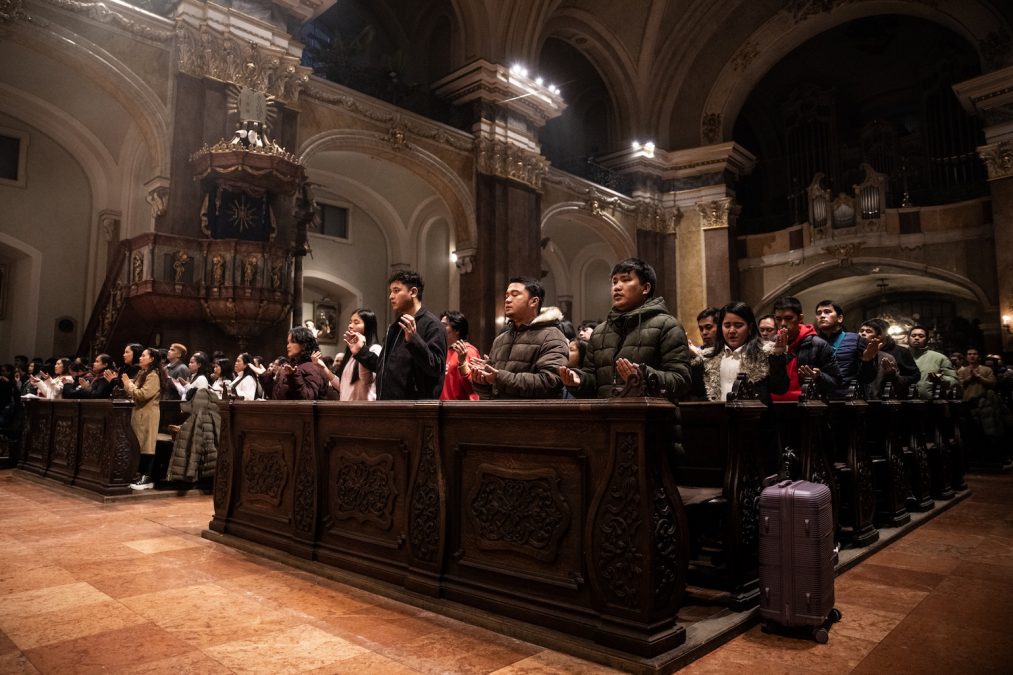
Every guest worker we spoke to agreed: in the Philippines, faith is more deeply woven into daily life than here. Leah de Leon felt she was raising her two children in a cultural headwind in Budapest – they were the only ones in their class who regularly attended Mass. The numbers bear this out. In 2017, 12 percent of Hungarian Catholics attended Mass weekly; among Filipinos, the figure is 41 percent. If we include those who attend at least monthly, that rises to four-fifths of Filipino Catholics. Yet even this data was greeted with anxiety at home, since it shows that secularisation has begun there too.
Corruption and the Philippine’s Rosary Miracle
Filipino Catholicism is less doctrinal and catechism-driven, and more a living tradition. Popular devotion plays a major role: rosary circles, novenas, parish feasts, processions. Every year in Manila, millions take part in the procession that carries the statue of Jesus known as the “Black Nazarene” from the Church of Saint Nicholas of Tolentino to the Quiapo Basilica. Popular religiosity can sometimes be taken to extremes: the Good Friday rituals of self-flagellation and even self-crucifixion are known worldwide, though these are practices of a small minority, firmly condemned by the Church as harmful expressions of spiritual vanity.
Faith also shapes public life. Ferdinand Marcos’s right-wing dictatorship fell in 1986 through what is remembered as the “rosary miracle”: in Manila, millions prayed the rosary during weeks of peaceful demonstrations – and the clergy took an active role in the protests. Faith also helps Filipinos bear the natural and political crises that strike their country, including systemic corruption. One scandal last year linked the two: many of the government’s promised flood-defence projects were poorly executed or never built at all. Floods destroyed villages and killed families, while fortunes were channelled to contractors and politicians close to the government. Father Phoebie also talked about this phenomenon in one of his Advent homilies.
“This case outrages us deeply, because people died. And yet, while similar scandals would spark waves of violence in other Asian countries, we see no aggression – because our faith does not allow it,” Leah says.
Hardship exists in the new, temporary homeland too. The most difficult part is being away from family. Mark, mentioned above, left behind his wife and two children, a two-year-old and a baby just eight months old. Yet he says he has no choice: his monthly earnings in Hungary are eight times what he could make at home, which allows him to support his family. “Most guest workers struggle with depression because they miss their families. This way of life has strengthened my faith; it brought me closer to God,” he says. His colleague, John Oducado, echoes the sentiment: “Weekly Mass eases the loneliness and anxiety most OFWs experience. In church I found a second family, true friends and support.”
Hungary brings other difficulties. “Most Filipinos struggle with the winter, the cold and the early darkness. In these months, community becomes especially important,” says Annamarie Sumande Ramirez, who has worked for three and a half years in the automotive sector as a materials planning specialist, and sings in the church choir.
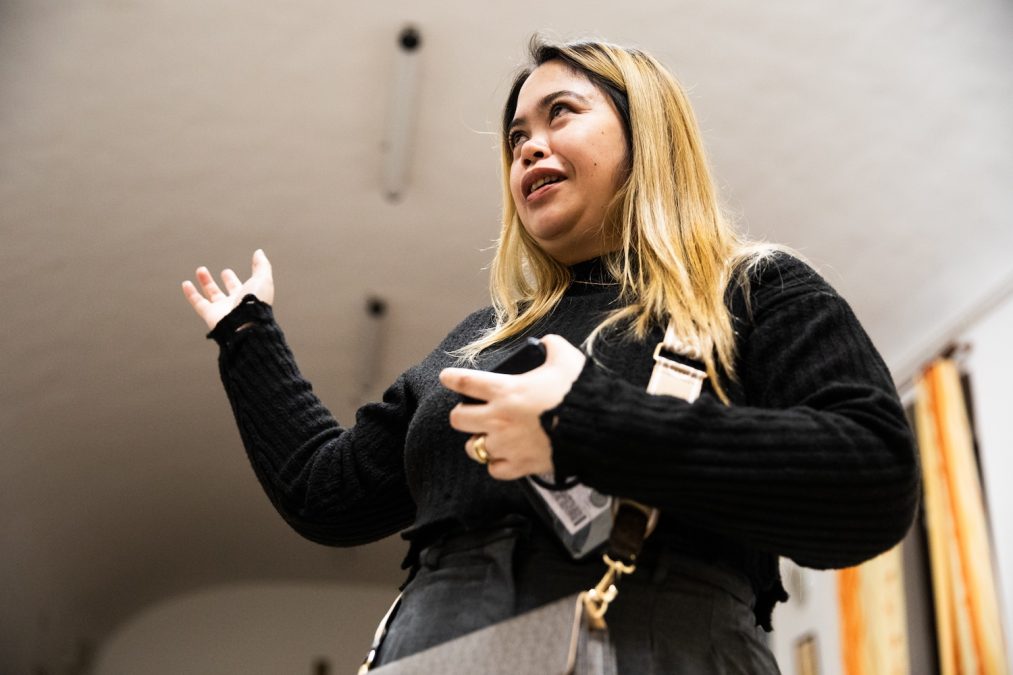
Naturally, faith also has a role in preserving identity. “For us, Sunday Mass is not an obligation but a return home – a moment of spiritual rest and renewal after a long week of work, a place where I do not feel alone because I am surrounded by God and a community where we can preserve our identity, and help each other live our everyday lives abroad,” says vaccine technician PJ Gabalfin.
Missionary support from the Franciscan brothers
When Filipinos began arriving in larger numbers, many employers were surprised to see them asking for a priest. Father Elmer encountered this firsthand: compatriots working in nearby factories started turning up at Sunday Mass in Vasvár – unaware that the priest serving there was himself Filipino. Soon afterwards, János Székely, Bishop of Szombathely, ordered that wherever guest workers were present, priests who spoke English should also celebrate Mass in English in the diocese. Later, Győr’s bishop, András Veres, approached Father Elmer as well, as that region too hosts many factories. He now travels to Győr Cathedral every third Sunday to celebrate Mass. Filipinos flock there from across Western Hungary, and although they make up most of the congregation, the liturgy is held in English rather than Tagalog, because foreign students also attend.
In Budapest, demand soon appeared as well. Central Hungary is rich in factories, and beyond the automotive sector, many Filipinos work in hospitality and the pharmaceutical industry. At first, they went to English-language Masses, but when Father Elmer received his coordinating assignment, he realised more was needed. In the end, support came from the Franciscan Order. Father Andrew Litigio arrived in Hungary for two months to assess the situation, and when he saw how great the need was, he recommended sending a younger confrere to Budapest – that became Father Phoebie.
They celebrated mass in the Országút Franciscan church in Buda on in November 2024 before the community found a permanent home on Ferenciek tere – with the full support of Father Peregrin Kálmán, the church director, and the entire Franciscan province. Father Phoebie also travels to Gyöngyös to say Mass – filling a similar role in the eastern half of the country to what Győr represents in the west. In Gyöngyös, we are told, Hungarian Catholics are especially fond of the cheerful Filipino faithful, who celebrate the liturgy with their whole hearts. They even cook for them.
Confession at the workers’ hostels
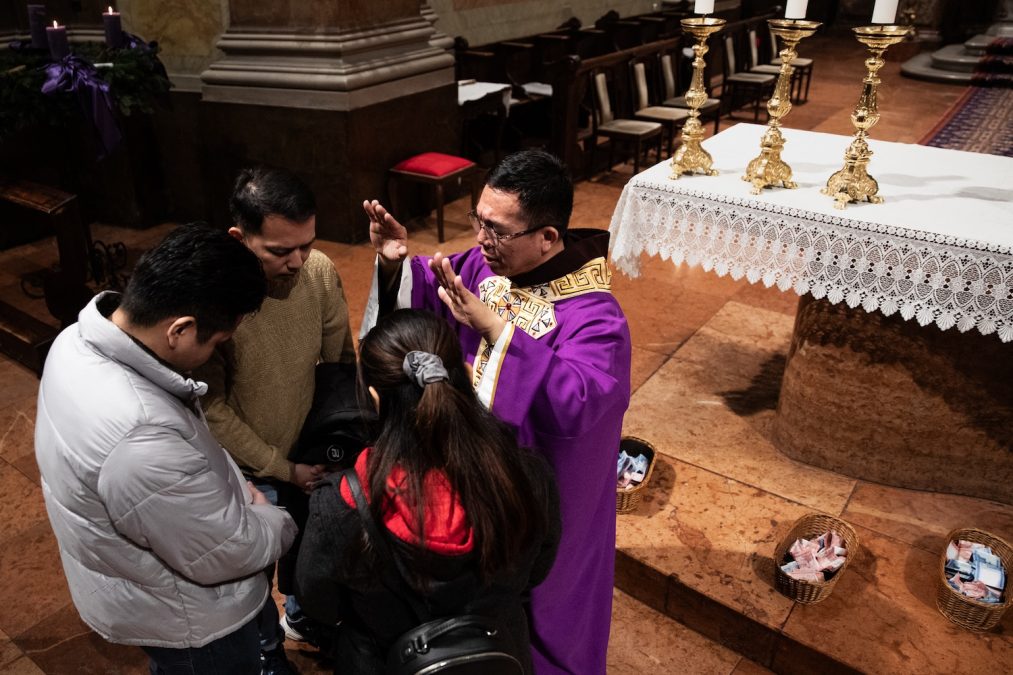
The church is not the only setting for evangelization. Father Elmer spends his weekdays in the workers’ hostels: hearing confessions, offering spiritual counselling. Guest workers welcome him proudly into their often modest rooms for the night, offer him food, and send glowing photos home – for them, hosting a priest is an honour. The practice mirrors what happens back home, where priests living in regional centres regularly travel to distant rural areas for pastoral care. He also helps his compatriots navigate linguistic and cultural barriers – advising, for example, that one does not walk into a shop saying Szia!, but Jó napot kívánok!, or encouraging them to stand up for themselves, to pay attention to what they sign, and to ensure their employers deliver on their contracts.
“As a child I only had a rough idea what life was like for migrant workers. Now I know – and I understand my parents much better. And I can give today’s migrant workers the support my parents never received. This mission is a great gift to me; it has given me countless brothers and sisters,” he says.
The guest workers we spoke to generally have good experiences at their workplaces. Mark works alongside Hungarians, Ukrainians and Indonesians. Although they mostly have time to talk only in the locker room, canteen or smoking area, there is a strong sense of camaraderie. Hungarian colleagues even expressed concern about what would happen to his contract now that orders have slowed. Annamarie was pleasantly surprised by workplace etiquette: in her Budapest office everyone greets everyone else, whereas back home people are more likely just to exchange glances. “It’s easy to get along with us – we’re always smiling, and social harmony matters to us,” adds Leah. They encounter racist remarks in the rarest cases, and not from colleagues but occasionally on public transport or from homeless people. Virtually all agree: Hungarians are warm and welcoming.


To stay or to go?
Hungarian employers value Filipino workers. Their work ethic and the quality of their labour have earned an excellent reputation, and it is no accident that many have their contracts extended for another two years once the initial term expires. Some are even entertaining the idea of remaining in Hungary for the long term.
It is a sensitive subject. The Hungarian government stresses at every turn that guest work is not the same as migration. Yet in a recent interview with the German tabloid Bild, Prime Minister Viktor Orbán said that if Filipinos “honestly work through their first two years, and behave well – no crime, normal conduct – they can extend their stay, and may even apply for citizenship”. The statement was immediately seized upon by Mi Hazánk, a far-right party building its 2026 elector campaign on agitation against guest workers. And yet, given Hungary’s demographic trends, the country will sooner or later need a calm, realistic conversation about immigration – and consider, if immigrants are needed, from where, whom and how it makes sense to welcome them.
“I would love to stay. I have three daughters, and it would make me so happy if they could go to university in Hungary,” says Annamarie Ramirez.
At present, thirty Filipino students per year can study in Hungary on scholarship, but the two countries are negotiating to expand higher-education cooperation – so her dream may not be out of reach.
Joe Freedom Dela Cruz has worked for three and a half years as a kitchen supervisor in a Budapest restaurant, while also singing in the choir at Ferenciek Square. He has few Hungarian colleagues in the kitchen, and works mainly with other Asians, but his experience is that Hungarians are kind and patient; he would gladly move his family here. The same goes for Lucky Rebosa Tiglao, an automotive technician who travels from Kecskemét to sing at Mass in Budapest. He also worked in Japan, but would not mind if his wife and two children eventually settled in Hungary. He has spent three years here, and his experiences have been overwhelmingly positive.
Others, however, are determined to return home once they have secured a stable financial future for their families. For some, caring for ill family members makes European settlement impossible in any case. Father Elmer sums up the dilemma succinctly: “We want nothing bad. We did not force ourselves in. We were given an opportunity, and we accepted it with gratitude. If they want us to stay, we stay; if they send us home, we go. We do not push – that is our default setting.”
Cover photo: Advent service in the Franciscan Church in Budapest downtown (Szabolcs Vörös / Valasz Online)
We couldn’t have published this article without our readers. Become our supporter on Donably, the secure, Hungarian-developed subscription platform. Paypal, transfer and other options here >>>

